(Coutesy of CK Chew)
So you think you can skate? Check this girl out, she is truly amazing.
Monday, June 27, 2011


Wednesday, June 22, 2011
New Words for 2011
(Courtesy of Ian)
Simon says: - Some of these phrases are sexist, others are offensive, some are even sexist and offensive. Please don't shoot the messenger and if you think it's gonna be an issue then don't be a NUMPTY, just click close. YOU HAVE BEEN WARNED.
* TESTICULATING
Waving your arms around and talking bollocks.
* BLAMESTORMING
Sitting round in a group, discussing why a deadline was missed or a project failed and who was responsible.
* SEAGULL MANAGER
A manager who flies in, makes a lot of noise, craps on everything and then leaves.
* SALMON DAY
The experience of spending an entire day swimming upstream only to get screwed and die.
* CUBE FARM
An office filled with cubicles.
* PRAIRIE DOGGING
When someone yells or drops something loudly in a cube farm and people's heads pop up over the walls to see what's going on. (This also applies to applause for a promotion because there may be cake.)
* SALAD DODGER
An excellent phrase for an overweight person.
* SWAMP DONKEY
A deeply unattractive person..
* AEROPLANE BLONDE
One who has bleached/dyed her hair but still has a 'black box'.
* PERCUSSIVE MAINTENANCE
The fine art of whacking the crap out of an electronic device to get it to work again.
* OH-NO SECOND
That minuscule fraction of time in which you realize that you've just made a BIG mistake. (e.g. You've hit 'reply all').
* GREYHOUND
A very short skirt, only an inch from the hare.
* MILLENNIUM DOMES
The contents of a Wonder bra, I..e. Extremely impressive when viewed from the outside but there's actually naught in there worth seeing.
* MONKEY BATH
A bath so hot, that when lowering yourself in, you go: 'Oo! Oo! Oo! Aa! Aa! Aa!'.
* MYSTERY BUS
The bus that arrives at the pub on Friday night while you're in the toilet after your 10th pint and whisks away all the unattractive people so the pub is suddenly packed with stunners when you come back in.
* TART FUEL
Bottled premixed spirits, regularly consumed by young women.
* TRAMP STAMP
Tattoo on a female.
* PICASSO BUM
A woman whose knickers are too small for her, so she looks like she's got 4 buttocks.
Simon says: - Some of these phrases are sexist, others are offensive, some are even sexist and offensive. Please don't shoot the messenger and if you think it's gonna be an issue then don't be a NUMPTY, just click close. YOU HAVE BEEN WARNED.
* TESTICULATING
Waving your arms around and talking bollocks.
* BLAMESTORMING
Sitting round in a group, discussing why a deadline was missed or a project failed and who was responsible.
* SEAGULL MANAGER
A manager who flies in, makes a lot of noise, craps on everything and then leaves.
* SALMON DAY
The experience of spending an entire day swimming upstream only to get screwed and die.
* CUBE FARM
An office filled with cubicles.
* PRAIRIE DOGGING
When someone yells or drops something loudly in a cube farm and people's heads pop up over the walls to see what's going on. (This also applies to applause for a promotion because there may be cake.)
* SALAD DODGER
An excellent phrase for an overweight person.
* SWAMP DONKEY
A deeply unattractive person..
* AEROPLANE BLONDE
One who has bleached/dyed her hair but still has a 'black box'.
* PERCUSSIVE MAINTENANCE
The fine art of whacking the crap out of an electronic device to get it to work again.
* OH-NO SECOND
That minuscule fraction of time in which you realize that you've just made a BIG mistake. (e.g. You've hit 'reply all').
* GREYHOUND
A very short skirt, only an inch from the hare.
* MILLENNIUM DOMES
The contents of a Wonder bra, I..e. Extremely impressive when viewed from the outside but there's actually naught in there worth seeing.
* MONKEY BATH
A bath so hot, that when lowering yourself in, you go: 'Oo! Oo! Oo! Aa! Aa! Aa!'.
* MYSTERY BUS
The bus that arrives at the pub on Friday night while you're in the toilet after your 10th pint and whisks away all the unattractive people so the pub is suddenly packed with stunners when you come back in.
* TART FUEL
Bottled premixed spirits, regularly consumed by young women.
* TRAMP STAMP
Tattoo on a female.
* PICASSO BUM
A woman whose knickers are too small for her, so she looks like she's got 4 buttocks.
Tuesday, June 21, 2011
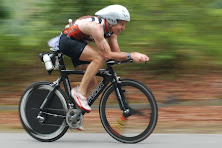
How to become a strong cyclist
(Photos courtesy of Tey)
 I've often been asked how do I pull off such good bike splits in an Ironman and half Ironman.
But first, going off on a tangent, my buddy Richard Tang recently gave me a video about Ironman preparation. Of course "I knew it all" BUT as is often the case I don't always practise and execute it all! One of the points they made on the video was that "There is no such thing as a good Ironman bike split if you're walking on the run" Oh Lordy, how true is that? AM I LISTENING? I hope so.
So, leaving my poor Ironman race management to one side for a moment, how do I regularly pull off sub 5hr 180k rides? I believe the answers are simple enough: -
1) Ride a lot. And I mean a lot. I average over 200k a week each year, with illness, burnout, holidays, family commitments and work etc that means many many weeks of 300 and 400k riding to get an average of over 200k per week.
2) Embrace the pain. If you're not able to find some love for the pain then the guy that has done the same mileage as you is going to leave you behind every time.
It that it?...ALMOST!
I believe the secret then is three specific sessions: -
Workout A) The weekend long ride. How long? Depends on your reference points but I consider "long" to be anything over 140k but to be honest for Ironman training 180K+ is my number. No breakfast stops (eat on the go), no hanging around, no chatting, no resting, just refill your bottles and go. It takes long enough as it is and quite honestly you should be running straight afterwards if you're training for an Ironman. So just get on with it.
Workout B) The midweek moderate distance, higher intensity, brick ride/run. How long? Again it depends upon your reference points but based on the numbers above I'd say between 50k and 90k followed by between 8k and 21k run.
Workout C) This workout is a major motivation to writing this article. The article has been inspired by many people asking me what are the secrets and me telling them of points 1) and 2) and the specific workouts of A) and B) above which most people get (and then don't do! haha) but Workout C) most people don't get, choose not to get and quite honestly phase it out of their mind as soon as they start thinking about the reality of it. To be be fair though, some people have actually tried Workout C)...once and sometimes even twice haha. I don't personally know anyone that does it regularly, except me.
The problem is that this workout needs to be done every week as a standard "bread and butter" session, year round. But when training for Ironman, it needs to be done twice a week. Difficult when you consider that Workouts A) and B) above also need to be completed.
 So here it is, the workout is a combination of distance(time), resistance and a lot of mind numbing pain, THE HIGH RESISTANCE INTERVAL session. I do these sessions on a turbo trainer in order to correctly manage what I'm trying to achieve. I do it while watching "shoot em up" movies or American TV comedies, basically "rubbish" that you don't need to concentrate on. Trust me you can't concentrate on the TV if you're doing these sessions right, they're designed to hurt body, mind and soul.
Sound like fun? You're right, they're not, but what doesn't kill body, mind and soul, makes the body, mind and sole stronger, MUCH STRONGER.
Generally on Mondays (two days after my long bike/run brick and one day after my long run) I do a 20 minute warm up with moderate resistance followed by 31x1 minute reps of FULL RESISTANCE. (By full resistance I mean the magneto resistance on max and the heaviest gear). The cadence should be ~50. Each 1 minute rep is followed by 1 minute easy to moderate with the last easy one being a 10 minute warm down. That should be 1 hour 31 minutes of pure misery - I LOVE IT (in a twisted sort of a way). After 5 reps I'm usually close to tears but somehow I pull the full workout off every time.
Friday (Day before my long bike/run brick) I do 10 minutes warm up, 10 minutes moderate/hard resistance (cadence of about ~70), 10 minutes maximum resistance, heaviest gear (cadence ~50), 10 minutes easy. Followed by 5 reps of: - 6 minutes max resistance, heaviest gear, (cadence ~50) each 6 minute rep is followed by 3 minutes of easy to moderate with the last easy one being a 10 minute warm down. That should be 1 hour 32 minutes of more sexy, addictive, misery.
These workouts should and do leave me with rubbery legs struggling to get up the stairs. I swear by them, they're not singularly the secret to my strong cycling, but combine points 1 and 2, Workouts A), B) and C) and if it needs pointing out - YOU MUST DO THEM CONSISTENCY, then you have it. Follow this routine week in week out and you are going to be unstoppable.
The only danger then, as I have found out, is that it becomes tempting to crush the bike leg in an Ironman. Hence my new race strategy follows all of the points above, combined with a power meter to ensure that my ride is consistent from start to finish (efficiency) and then smart race management (the number one item on the agenda of smart race management is to stick to what the power meter says and ignore Mr. Ego).
 [As we get older we don't necessarily get smarter...BUT to get faster that's all that we really have to work with, so hopefully I'll milk that reservoir of knowledge for a few years and then maybe go back to golf haha]
I truly hope that this post helps anyone aiming to become stronger on the bike. It works believe me but you've got to spend the time and embrace the pain. There are no short cuts.
But remember "There is no such thing as a good Ironman bike split if you're walking on the run" [I wrote this again as much for my own benefit as anyone else's haha]
 I've often been asked how do I pull off such good bike splits in an Ironman and half Ironman.
But first, going off on a tangent, my buddy Richard Tang recently gave me a video about Ironman preparation. Of course "I knew it all" BUT as is often the case I don't always practise and execute it all! One of the points they made on the video was that "There is no such thing as a good Ironman bike split if you're walking on the run" Oh Lordy, how true is that? AM I LISTENING? I hope so.
So, leaving my poor Ironman race management to one side for a moment, how do I regularly pull off sub 5hr 180k rides? I believe the answers are simple enough: -
1) Ride a lot. And I mean a lot. I average over 200k a week each year, with illness, burnout, holidays, family commitments and work etc that means many many weeks of 300 and 400k riding to get an average of over 200k per week.
2) Embrace the pain. If you're not able to find some love for the pain then the guy that has done the same mileage as you is going to leave you behind every time.
It that it?...ALMOST!
I believe the secret then is three specific sessions: -
Workout A) The weekend long ride. How long? Depends on your reference points but I consider "long" to be anything over 140k but to be honest for Ironman training 180K+ is my number. No breakfast stops (eat on the go), no hanging around, no chatting, no resting, just refill your bottles and go. It takes long enough as it is and quite honestly you should be running straight afterwards if you're training for an Ironman. So just get on with it.
Workout B) The midweek moderate distance, higher intensity, brick ride/run. How long? Again it depends upon your reference points but based on the numbers above I'd say between 50k and 90k followed by between 8k and 21k run.
Workout C) This workout is a major motivation to writing this article. The article has been inspired by many people asking me what are the secrets and me telling them of points 1) and 2) and the specific workouts of A) and B) above which most people get (and then don't do! haha) but Workout C) most people don't get, choose not to get and quite honestly phase it out of their mind as soon as they start thinking about the reality of it. To be be fair though, some people have actually tried Workout C)...once and sometimes even twice haha. I don't personally know anyone that does it regularly, except me.
The problem is that this workout needs to be done every week as a standard "bread and butter" session, year round. But when training for Ironman, it needs to be done twice a week. Difficult when you consider that Workouts A) and B) above also need to be completed.
 So here it is, the workout is a combination of distance(time), resistance and a lot of mind numbing pain, THE HIGH RESISTANCE INTERVAL session. I do these sessions on a turbo trainer in order to correctly manage what I'm trying to achieve. I do it while watching "shoot em up" movies or American TV comedies, basically "rubbish" that you don't need to concentrate on. Trust me you can't concentrate on the TV if you're doing these sessions right, they're designed to hurt body, mind and soul.
Sound like fun? You're right, they're not, but what doesn't kill body, mind and soul, makes the body, mind and sole stronger, MUCH STRONGER.
Generally on Mondays (two days after my long bike/run brick and one day after my long run) I do a 20 minute warm up with moderate resistance followed by 31x1 minute reps of FULL RESISTANCE. (By full resistance I mean the magneto resistance on max and the heaviest gear). The cadence should be ~50. Each 1 minute rep is followed by 1 minute easy to moderate with the last easy one being a 10 minute warm down. That should be 1 hour 31 minutes of pure misery - I LOVE IT (in a twisted sort of a way). After 5 reps I'm usually close to tears but somehow I pull the full workout off every time.
Friday (Day before my long bike/run brick) I do 10 minutes warm up, 10 minutes moderate/hard resistance (cadence of about ~70), 10 minutes maximum resistance, heaviest gear (cadence ~50), 10 minutes easy. Followed by 5 reps of: - 6 minutes max resistance, heaviest gear, (cadence ~50) each 6 minute rep is followed by 3 minutes of easy to moderate with the last easy one being a 10 minute warm down. That should be 1 hour 32 minutes of more sexy, addictive, misery.
These workouts should and do leave me with rubbery legs struggling to get up the stairs. I swear by them, they're not singularly the secret to my strong cycling, but combine points 1 and 2, Workouts A), B) and C) and if it needs pointing out - YOU MUST DO THEM CONSISTENCY, then you have it. Follow this routine week in week out and you are going to be unstoppable.
The only danger then, as I have found out, is that it becomes tempting to crush the bike leg in an Ironman. Hence my new race strategy follows all of the points above, combined with a power meter to ensure that my ride is consistent from start to finish (efficiency) and then smart race management (the number one item on the agenda of smart race management is to stick to what the power meter says and ignore Mr. Ego).
 [As we get older we don't necessarily get smarter...BUT to get faster that's all that we really have to work with, so hopefully I'll milk that reservoir of knowledge for a few years and then maybe go back to golf haha]
I truly hope that this post helps anyone aiming to become stronger on the bike. It works believe me but you've got to spend the time and embrace the pain. There are no short cuts.
But remember "There is no such thing as a good Ironman bike split if you're walking on the run" [I wrote this again as much for my own benefit as anyone else's haha]
Monday, June 20, 2011
Father's Day
 I got home from my run on Sunday to be presented with two beautiful handmade cards, two beautiful neck ties, an Ipod Shuffle and a new RoadID by most most awesomely beautiful boys. How cool was that?
 Not only that, we then went and met a bunch of friends from Alice Smith school and had a wonderful buffet lunch with all the kids, clowns, bouncy castles etc at the Shangri-La in Kuala Lumpur.
Sid and Seb then insisted on buying me something personal from money in their wallets. So I got some pumpernickel bread (my favourite) and a naval orange (my most favouritest fruit in the whole world).
I have no doubt I am the luckiest dad alive.
I love you so much Sid and Seb.
Mom & Pop's 40th Wedding Anniversary
 Recently it was Shilp's Mom and Dad's 40th Wedding Anniversary. The "kids", that's Shilpa, Meenu and Kapil (and there respective other halves, me, Ranjan and Ritu) organised 40 red roses for them (with the help of Ashley). Just a tiny token to acknowledge their amazing time together and the love and care that they shower on us daily.
Britain's Alistair Brownlee earns second Kitzbuhel win
(Courtesy of the BBC)
 Alistair Brownlee led from start to finish to win the Kitzbuhel triathlon for the second time and move clear of Javier Gomez in the World Championship Series.
With his brother Jonathan and Gomez both absent, Brownlee, 23, was fastest in the swim and the run, and joint-fastest in the cycling.
Russia's Alexander Brukhankov was second and Swiss Sven Riederer third.
Brownlee was in dominant form following his win in Madrid two weeks ago.
He was first out of the water and tied for the lead at the end of the cycling leg after breaking away from the pack with compatriot Stuart Hayes, winner in Kitzbuhel in 2010, and Brazil's Reinaldo Colucci.
The trio were 30 seconds in front of the chasing pack at the start of the run, but Brownlee had forged ahead by the end of the first lap and stayed there to win in Kitzbuhel for the second time in his career.
Brukhankov split from the trailing bunch with five kilometres to run and hung on for silver.
Riederer left it until the final lap to make his bid for bronze, his second of the Series after coming third in Sydney.
In what is Olympic selection year, Brownlee leads the Championship with 1,690 points. Brukhankov is second on 1,663 points, with Gomez third (1,485) and Jonathan Brownlee (1480) fourth.
 Alistair Brownlee led from start to finish to win the Kitzbuhel triathlon for the second time and move clear of Javier Gomez in the World Championship Series.
With his brother Jonathan and Gomez both absent, Brownlee, 23, was fastest in the swim and the run, and joint-fastest in the cycling.
Russia's Alexander Brukhankov was second and Swiss Sven Riederer third.
Brownlee was in dominant form following his win in Madrid two weeks ago.
He was first out of the water and tied for the lead at the end of the cycling leg after breaking away from the pack with compatriot Stuart Hayes, winner in Kitzbuhel in 2010, and Brazil's Reinaldo Colucci.
The trio were 30 seconds in front of the chasing pack at the start of the run, but Brownlee had forged ahead by the end of the first lap and stayed there to win in Kitzbuhel for the second time in his career.
Brukhankov split from the trailing bunch with five kilometres to run and hung on for silver.
Riederer left it until the final lap to make his bid for bronze, his second of the Series after coming third in Sydney.
In what is Olympic selection year, Brownlee leads the Championship with 1,690 points. Brukhankov is second on 1,663 points, with Gomez third (1,485) and Jonathan Brownlee (1480) fourth.
Panic Attacks (in a triathlon swim)
 A friend of mine raced in an Olympic distance triathlon on Saturday and had a panic attack the second he hit the water at the start. He's not your typical triathlete though, he has been doing tris for the last two decades, has done numerous Ironmans and qualified for the Ironman worlds in Kona last year and the 70.3 Worlds in Clearwater the year before. Strangely this is the second panic attack he has had in two races.
I gave him my "take on it" in the hope that it will help somehow but then I thought I'd adapt my thoughts for anyone else that has experienced this sickening feeling. For the record I had my own panic attack/near death experience at the Alpe d'Huez triathlon a couple of years ago, so I'm not immune and I know what they're like.
So here's my take on it for what it's worth: -
My buddy freely admits he was under prepared and hadn't swam for 3 weeks. He's strong though and very fit. In my opinion the lack of swimming shouldn't have done more than taken a minute or two off his time at worst. I think his biggest mistake was not warming up by doing 500 metres swim/drills (or a full ten minutes of swimming). The fact that the water was undoubtedly colder than the pool and he didn't use a wetsuit probably magnified the problem.
A proper swim warm up in ANY distance tri is the difference between me being in the top half and the bottom half of the swim, so panic attacks aside, I reckon anyone that doesn't do a full and intensive warm up are giving away heaps of time and potentially spoiling their day because of a panic attack.
 Don't forget we are not meant to be swimmers, we are land animals and probably one of the least adapted land animals to water. So suddenly going from a near resting heart rate to potentially anaerobic at the start of a triathlon is going to give the body, heart and mind a bit of a shock to say the least. Throw into the mix cold water and I'm sure many would experience some degree of shock.
(Cold water is something we don't have to worry about in Malaysia but when we travel elsewhere it can be an even bigger shock for us softie warm weather types).
So why did I have a panic attack at Alpe d'Huez? That's easy: -
1) I was under prepared
2) The reservoir we were swimming in didn't allow us into the water until 2 minutes before the start there was no warm up (it was a hydroelectric dam & French bureaucrats running it)
3) The water was pretty darn cold
4) I hadn't swam in a wetsuit for months if not a couple of years
The combination was a recipe for disaster. Having said that, I'm fairly sure that a 10 minute brisk warm up would have eliminated all my problems. (If I did this race again I'd go for a jog first in my wetsuit and be first in the water once we were allowed to go in).
I hope that those that have panic attacks don't consider this article too presumptive. I've addressed my take on panic attacks that occur at the beginning of a swim start as I have had personal experience of this.
However, another of my close Ironman friends has swim panic attacks mid swim. He says these are due simply to being out in the middle of nowhere in the ocean or a large lake. That's a different trigger I guess and I don't feel qualified to comment on that one. I'm sure he'll be interested if anyone has experienced that sort of panic attack and found ways to combat it. I'll forward any comments onto him, so please do share.
Additional Feedback: -
One of the comments left on this post by Ann, was that she used to have panic attacks. However, subsequently she realised they weren't actually panic attacks but rather she'd gone out to fast and I assume she'd gone anaerobic.
Pretty scary in a race let me tell you, YES I'VE BEEN DAFT ENOUGH TO DO THAT TOO. In fact that was the closest I ever came to dying. I shot out from the start, went anaerobic in a big way and then got swam over by the chasing field. I literally could not move my arms and could barely keep my head above the water. I got to the first turn buoy and hung on. Once I recovered I swam the course gingerly and finished the race, scared, embarrassed AND EDUCATED.
Tuesday, June 14, 2011
The great SWEAT dilemma
I had a short debate on Twitter yesterday with some buddies. They (and many others) are always incredulous when I state that I suffer more than most in the heat. I've lived in South East Asia for about 20 years and as I'm sure you will be aware it is very hot and very humid 24/7 365.
Yes you do acclimatise to some degree but genetics play a major role. The simple fact is that being of Anglo-Saxon heritage not to mention relatively short and compact I heat up very quickly and start sweating at the slightest excuse.
There are three main types of body classification Ectomorph, Mesomorph or Endomorph. Guess which one I am?
(Courtesy of muscleandstrength.com)
 ECTOMORPH
An ectomorph is a typical skinny guy. Ecto’s have a light build with small joints and lean muscle. Usually ectomorph’s have long thin limbs with stringy muscles. Shoulders tend to be thin with little width.
Typical traits of an ectomorph:
•Small “delicate” frame and bone structure
•Classic “hardgainer”
•Flat chest
•Small shoulders
•Thin
•Lean muscle mass
•Finds it hard to gain weight
•Fast metabolism
Ectomorphs find it very hard to gain weight. They have a fast metabolism which burns up calories very quickly. Ecto’s need a huge amount of calories in order to gain weight.
 MESOMORPH
A mesomorph has a large bone structure, large muscles and a naturally athletic physique. They find it quite easy to gain and lose weight. They are naturally strong which is the perfect platform for building muscle.
Typical traits on a Mesomorph:
•Athletic
•Hard body with well defined muscles
•Rectangular shaped body
•Strong
•Gains muscle easily
•Gains fat more easily than ectomorphs
The mesomorph body type gains muscle easily and very quickly. The downside to mesomorphs is they gain fat more easily than ectomorphs. This means they must watch their calorie intake. Usually a combination of weight training and cardio works best for mesomorphs.
 ENDOMORPH
The endomorph body type is solid and generally soft. Endomorphs gain fat very easily. Endo’s are usually of a shorter build with thick arms and legs. Muscles are strong, especially the upper legs. Endomorphs find they are naturally strong in leg exercises like the squat.
Typical traits of an Endomorph:
•Soft and round body
•Gains muscle and fat very easily
•Is generally short and “stocky”
•Round physique
•Finds it hard to lose fat
•Slow metabolism
When it comes to training endomorphs find it very easy to gain weight. Unfortunately, a large portion of this weight is fat not muscle. To keep fat gain to a minimum, endomorphs must focus on cardio.
Yes I'm a 100% endomorph and an additional trait of us short, stocky, round types is that our stocky muscles generate heat more quickly than the other body types AND find it more difficult to eliminate due to our body shape. There is less surface area for the heat to escape, plus the naturally higher fat content of our bodies acts as additional insulation keeping the heat in.
The body deals with excess heat by sweating and in the case of endomorph's the higher levels of heat increase the amount of sweat. Add to that a trained triathlete's sweat glands are highly tuned and very efficient at their job, hence the sweat pours out.
The body sweats in order for the liquid to evaporate from the skin i.e. changing liquid to gas. To convert a liquid to a gas takes energy and the energy used is taken from the heat of your body, thus cooling it.
However, this method of cooling all breaks down in climates with extremely high humidity. The simple fact is that very little evaporation takes place due to the saturated state of the humid air and the sweat simply rolls off the body. It does of course take away some heat but only a fraction as much compared to the process of evaporation.
In my debate I stated that I sweat at a rate of 3 litres an hour - there was "doubt" cast by one or two of the debaters, so here is an extract from Active.com on the subject.
"Average and Champion Sweat Rates
How much do we sweat? An average person sweats between 0.8 to 1.4 liters (roughly 27.4 to 47.3 oz.) per hour during exercise. To help you with a visual, the smaller bike water bottles typically hold 0.6 liters (20 oz.) of fluid and the larger bottles hold 0.7 liters (24 oz.) of fluid.
The highest recorded sweat rate for an athlete in an exercise situation is 3.7 liters (125 oz.) per hour, recorded by Alberto Salazar while preparing for the 1984 Summer Olympics. The highest human sweat rate recorded is 5 liters (169 oz.) per hour measured on a resting body exposed to a hot environment. At rest, the skin blood flow was maximum and not competing with exercising muscles.
How do you know if you are an average sweaty person or a champion sweater? You need to do some testing.
Your Sweat Rate Test
The easiest way to measure your sweat rate is to weigh yourself without clothes on before exercising for one hour. After an hour of exercise, return home, strip down and weigh yourself again. Assuming you did not use the toilet or consume any fluids during exercise, your weight loss is your sweat rate. For each kilogram of lost weight, you lost one liter of fluid. (For each pound lost, you lost 15.4 oz. of fluid.)
If you drink any fluids or use the rest room between the two weight samples, you'll need to include both of these estimated weights in your calculations. Add fluid consumed to the amount of weight lost. Subtract estimated bodily void weight from the total weight lost."
The whole article can be found here.Yes you do acclimatise to some degree but genetics play a major role. The simple fact is that being of Anglo-Saxon heritage not to mention relatively short and compact I heat up very quickly and start sweating at the slightest excuse.
There are three main types of body classification Ectomorph, Mesomorph or Endomorph. Guess which one I am?
(Courtesy of muscleandstrength.com)
 ECTOMORPH
An ectomorph is a typical skinny guy. Ecto’s have a light build with small joints and lean muscle. Usually ectomorph’s have long thin limbs with stringy muscles. Shoulders tend to be thin with little width.
Typical traits of an ectomorph:
•Small “delicate” frame and bone structure
•Classic “hardgainer”
•Flat chest
•Small shoulders
•Thin
•Lean muscle mass
•Finds it hard to gain weight
•Fast metabolism
Ectomorphs find it very hard to gain weight. They have a fast metabolism which burns up calories very quickly. Ecto’s need a huge amount of calories in order to gain weight.
 MESOMORPH
A mesomorph has a large bone structure, large muscles and a naturally athletic physique. They find it quite easy to gain and lose weight. They are naturally strong which is the perfect platform for building muscle.
Typical traits on a Mesomorph:
•Athletic
•Hard body with well defined muscles
•Rectangular shaped body
•Strong
•Gains muscle easily
•Gains fat more easily than ectomorphs
The mesomorph body type gains muscle easily and very quickly. The downside to mesomorphs is they gain fat more easily than ectomorphs. This means they must watch their calorie intake. Usually a combination of weight training and cardio works best for mesomorphs.
 ENDOMORPH
The endomorph body type is solid and generally soft. Endomorphs gain fat very easily. Endo’s are usually of a shorter build with thick arms and legs. Muscles are strong, especially the upper legs. Endomorphs find they are naturally strong in leg exercises like the squat.
Typical traits of an Endomorph:
•Soft and round body
•Gains muscle and fat very easily
•Is generally short and “stocky”
•Round physique
•Finds it hard to lose fat
•Slow metabolism
When it comes to training endomorphs find it very easy to gain weight. Unfortunately, a large portion of this weight is fat not muscle. To keep fat gain to a minimum, endomorphs must focus on cardio.
Yes I'm a 100% endomorph and an additional trait of us short, stocky, round types is that our stocky muscles generate heat more quickly than the other body types AND find it more difficult to eliminate due to our body shape. There is less surface area for the heat to escape, plus the naturally higher fat content of our bodies acts as additional insulation keeping the heat in.
The body deals with excess heat by sweating and in the case of endomorph's the higher levels of heat increase the amount of sweat. Add to that a trained triathlete's sweat glands are highly tuned and very efficient at their job, hence the sweat pours out.
The body sweats in order for the liquid to evaporate from the skin i.e. changing liquid to gas. To convert a liquid to a gas takes energy and the energy used is taken from the heat of your body, thus cooling it.
However, this method of cooling all breaks down in climates with extremely high humidity. The simple fact is that very little evaporation takes place due to the saturated state of the humid air and the sweat simply rolls off the body. It does of course take away some heat but only a fraction as much compared to the process of evaporation.
In my debate I stated that I sweat at a rate of 3 litres an hour - there was "doubt" cast by one or two of the debaters, so here is an extract from Active.com on the subject.
"Average and Champion Sweat Rates
How much do we sweat? An average person sweats between 0.8 to 1.4 liters (roughly 27.4 to 47.3 oz.) per hour during exercise. To help you with a visual, the smaller bike water bottles typically hold 0.6 liters (20 oz.) of fluid and the larger bottles hold 0.7 liters (24 oz.) of fluid.
The highest recorded sweat rate for an athlete in an exercise situation is 3.7 liters (125 oz.) per hour, recorded by Alberto Salazar while preparing for the 1984 Summer Olympics. The highest human sweat rate recorded is 5 liters (169 oz.) per hour measured on a resting body exposed to a hot environment. At rest, the skin blood flow was maximum and not competing with exercising muscles.
How do you know if you are an average sweaty person or a champion sweater? You need to do some testing.
Your Sweat Rate Test
The easiest way to measure your sweat rate is to weigh yourself without clothes on before exercising for one hour. After an hour of exercise, return home, strip down and weigh yourself again. Assuming you did not use the toilet or consume any fluids during exercise, your weight loss is your sweat rate. For each kilogram of lost weight, you lost one liter of fluid. (For each pound lost, you lost 15.4 oz. of fluid.)
If you drink any fluids or use the rest room between the two weight samples, you'll need to include both of these estimated weights in your calculations. Add fluid consumed to the amount of weight lost. Subtract estimated bodily void weight from the total weight lost."
Most sources I've read state that during exercise a human can absorb between 1 and 1.5ltrs of fluid an hour. Working on the higher level of 1.5ltrs that means that we endomorphs will likely be in a huge deficit in an typical hot/humid Ironman race. I have often lost 10kg in an Ironman and needless to say the second half of the run is pretty ugly.
Again most sources I've read state that performance begins to be negatively affected with just 1-2% of fluid loss. You can start to see how much fun Ironmans become for me at over 13% loss of fluid body weight. See the graph below.

Adapted from Wilmore & Costill (1999) ‘Physiology of Sport & Exercise’. Human Kinetics.
So what to do?
As best as I can work out entering more races in cooler climates is a good call. Sadly though the heat follows me EVERYWHERE. At Ironman China last year I was positively freezing 3 days before the race but come race day it was close to 40C.
Certainly a really disciplined drinking strategy is called for. Especially on the bike where it's easier to ingest. Making sure that there is never a moment when my stomach doesn't have at least some fluid being absorbed. As mentioned earlier though, there is only so much that can be absorbed and if it is below the sweat rate then there's going to be some serious payback, usually somewhere on the run.
So the solution is...? Lose some weight you fat bast*rd...haha That is my solution. Reduce the stress on the body for the hills and the run, reduce the insulation and thus have more of the blood closer to the skin's surface to promote as much cooling as possible. Easier said than done, I'm and endomorph don't forget and I like to party and love food. Add to that, as soon as I start losing weight it goes from my face first and everyone starts telling me I look ill and drawn.
I'll get over the criticism and I'll do my best to HTFU on the diet front. It's been interesting writing this and researching stuff on the net. This is my last hard week of training before a two week taper for Ironman Korea. I'm far from my best but these three weeks can get me close to where I need to be and hopefully a shot at a qualifying spot for Kona. Failing that it'll be all about recovery and then try again three weeks later at Ironman Lake Placid.
Interesting times. I'm just hoping that the heat gods don't follow me to these two races. Needless to say, I check the projected weather forecast for Jeju, Korea ALOT haha.
Wednesday, June 08, 2011
Zipp Firecrest 404s are the new 808s
 (Courtesy of www.slowtwitch.com)
At the end of the 3rd stage of the 2007 Tour de France, Fabian Cancellara famously attacked the field from 1km out and managed to hold off a charging swarm of sprinters to win the stage. On that day he was riding a Cervelo Soloist shod with Zipp model 808 wheels. Afterwards, he excitedly told Zipp's Chief Engineer Josh Poertner "808 is the new 404 for me!" Jens Voigt had been riding Zipp's 808 wheels in flat stages and seeing this, Cancellara had decided to try them as well. As he related to Poertner later, "I just felt like when I went, I knew I was riding a TT bike compared to what these other guys were on." Obviously, the potential of aerodynamics (especially of the wheels) to have a decisive effect in a bike race was not lost on Mr. Cancellara.
Let's fast forward to 2010-2011. In May of 2010, Zipp announced a reworking of their 404 wheels with a completely new shape for that wheel's depth of 58mm. These wheels appear to turn Spartacus' 2007 quote on it's head. In many ways these new wheels equal or outperform the 808s that Fabian rode to victory in 2007. Now then, I'm no Fabian Cancellara (I'd be lucky if I'm equivalent to just ONE of his legs), however, after recently riding a set of the new Zipp Firecrest 404 carbon clincher wheels and digging through the data produced by Zipp and comparing it to my own observations, I'm beginning to think that a new quote is appropriate: "Firecrest 404 is the new 808!"
 Firecrest Shape Development
During the development of the Firecrest 404 wheels, Zipp engineers decided to take a slightly different approach than has typically been used in thinking about and designing the rim shape. In the past, they general approach has been to think about the tire as the leading edge of an aerodynamic foil and then designing the rim shape with that as the foremost assumption. Doing so works fairly well, but the trade-off in that decision is that this shape may not work particularly well in the rear part of the wheel, where the shape is "reversed" to the air flow. In other words, the approach was to design for the front half of the wheel to be as good as possible, and then the rear "is what it is". In some cases, the rim designers don't even go to that extent, and this is evidenced by the "V" shaped rims still being produced. Those shapes aren't even particularly good for the front half of the wheel.
With their previous generation of rim shapes (what they called "hybrid toroidal"), the Zipp engineers had done a fairly good job of coming up with a shape that works really well on the front half of the wheel across a wide range of yaws, and is also relatively insensitive to tire width. Even so, this shape, when "reversed" on the trailing half of the wheel, didn't perform anywhere near as well as it did on the leading half of the wheel. So, the new thought process used in designing the Firecrest wheels was to see if tweaks could be made to the rim shape to get the rear half of the wheel to perform closer to the front half of the wheel, without adversely affecting the front half performance. This sounds like a great engineering challenge. Accomplishing this task would eek just a bit more performance out of the wheels, especially in a cross-wind situation.
Well…they did it…and it took taking the typical wheel design approach described above and basically "turning it on it's head". If you take a look at the new Firecrest shape that the Zipp engineers came up with and concentrate on a cross-section through the trailing half of the wheel, you can see that it looks as though the shape was designed with the thought of the tire being the trailing edge of the "wing section"…in almost a "Kamm" style of foil design. The Kamm concept is, simply put, the concept that a truncated airfoil section can have nearly the same drag as the entire foil would have, as long as the truncation is placed in the right spot. Kamm foils have received a lot of attention lately due to their use in the Trek Speed Concept frame tubing, but Zipp actually started using the concept on their wheels around three years ago in the pinch nuts of the 88/188 hubs. Using the Kamm shape on those pinch nuts actually allowed them to have that portion of a 17mm diameter axle have the same drag as the equivalent portion of 12mm round axle section, so obviously the advantages are understood.
According to Josh Poertner, the new shape dramatically improves the drag of the rear half of the 404 wheels, and they were actually able to make tweaks so that the front half of the wheel performance is as good as the old shapes. That's quite an impressive accomplishment.
One side benefit (pun intended) of improving the drag performance of the rear half of the wheels is that the location of the center of effort of the side force acting on the wheels is moved slightly rearward, which aligns it better with the steering axis of the bike. Side force in deep section wheels can be both a blessing and a curse…a blessing because it's the deep sections of the rims creating "lift" through air flow that results in that side force, but it also can be a curse if the effective center of that side force (i.e. if you replaced the overall side force with a single force at a point) is significantly offset from the bike steering axis. This then creates a torque about the steering axis depending on wind strength and direction and is what can make a wheel a handful in windy, gusty situations. However, moving the center of effort closer to the steering axis reduces these torques, and thus reduces the wheel's "twitchy-ness" in sidewinds.
This is actually what the Zipp engineering team was able to accomplish; lower drag AND lower side force induced torque abut the steering axis.
 So, what's the bottom line? How well did the engineers do? Take a look at the drag plot released by Zipp, and in particular how the new Firecrest 404 shape compares to the previous 404 and 808 Zipp wheels.
From 0 to 10 degrees of yaw, the old 808 and the Firecrest 404 are nearly tied, with the 808 "beating" it by less than 10 grams of drag, or the equivalent of approximately 1 watt of power at race speeds (or, probably within the margin of error of the measurements.) Above 10 degrees of yaw however, the new 58mm deep Firecrest 404 shape is significantly faster than the older non-Firecrest 808 (the wheel Cancellara rode to victory as described above). Another "nifty" accomplishment by the Zipp engineering team was the fact that the drag performance for both the clincher and tubular versions of the wheel are identical. This hasn't always been the case for particular wheel designs.
For full article click here
Simon says: - This sounds very exciting (except the price) although I've gone one better (I hope) and have bought the Firecrest 808 tubular (Zedtech) front wheel. So I've got all the Firecrest technology/shape in the bigger cross-section of the 808 and with ceramic bearings of the Zedtech. Will it make me faster? A little I hope but most importantly it will now match my Zipp Sub 9 disc. I've got matching decals for both wheels too. I was always a little unhappy with the lack of match up between my Zipp disc and Hed 3 tri spoke. Let's be honest 95% of triathlon is all about the look! :)
Haha
Monday, June 06, 2011
Specialized - blowing up the competition
(Courtesy of Richard Tang)
Cool video
Cool video
www.simonwhitfield.com - "Yeah but can Cavendish do this?" (@markcavendish) from swhitfield on Vimeo.
Sunday, June 05, 2011
Alistair and Jonathan Brownlee 1st & 2nd in Madrid
(Courtesy of the BBC)
 Alistair Brownlee beat younger brother Jonathan by two seconds to win Madrid's World Championship Series race.
A third successive victory in the Spanish capital for Alistair, 23, piled the pressure on title rival Javier Gomez, who finished 44 seconds behind.
It was the Yorkshire brothers' first time together on the podium.
They were so far ahead that Alistair could even wait to celebrate with his brother before crossing the finish line in one hour 51 minutes, seven seconds.
Alistair said: "It had to happen some time and why not have it happen in Madrid, a race where I have done really well and such a fantastic course."
Jonathan added: "It was really good, we train hard together and it's a bit strange because we've done it in small races but never in a world series.
"It's a bit of a strange feeling but really nice that he waited for me - it was really a special moment."
Gomez said: "The Brownlees were just on a different level on the run, so I couldn't do too much.
"I tried on the first lap, I tried to follow them but I know that was not my pace. I was waiting to see if they would slow down but they didn't, they went faster and they smashed me."
After a fast swim, 12 athletes broke away early on the bike and opened up a 90 second gap by the second transition before the Brownlees dominated the run.
The decisive moment came when Alistair broke away with two kilometres to go - a move that the rest of the field had no answer to.
Reigning Olympic champion Jan Frodeno was sixth with Britons Will Clarke and Stuart Hayes finishing 24th and 35th, respectively.
The win puts both Brownlees in poll position for the Olympic qualification races in London in August and Beijing in September.
 Alistair Brownlee beat younger brother Jonathan by two seconds to win Madrid's World Championship Series race.
A third successive victory in the Spanish capital for Alistair, 23, piled the pressure on title rival Javier Gomez, who finished 44 seconds behind.
It was the Yorkshire brothers' first time together on the podium.
They were so far ahead that Alistair could even wait to celebrate with his brother before crossing the finish line in one hour 51 minutes, seven seconds.
Alistair said: "It had to happen some time and why not have it happen in Madrid, a race where I have done really well and such a fantastic course."
Jonathan added: "It was really good, we train hard together and it's a bit strange because we've done it in small races but never in a world series.
"It's a bit of a strange feeling but really nice that he waited for me - it was really a special moment."
Gomez said: "The Brownlees were just on a different level on the run, so I couldn't do too much.
"I tried on the first lap, I tried to follow them but I know that was not my pace. I was waiting to see if they would slow down but they didn't, they went faster and they smashed me."
After a fast swim, 12 athletes broke away early on the bike and opened up a 90 second gap by the second transition before the Brownlees dominated the run.
The decisive moment came when Alistair broke away with two kilometres to go - a move that the rest of the field had no answer to.
Reigning Olympic champion Jan Frodeno was sixth with Britons Will Clarke and Stuart Hayes finishing 24th and 35th, respectively.
The win puts both Brownlees in poll position for the Olympic qualification races in London in August and Beijing in September.
Wednesday, June 01, 2011
Danny MacAskill Plays Capetown
(Courtesy of Urban Ninja)
Simon says: - This guy really ROCKS. If I had 1% of his skill on my mountain bike I'd be a happy man!
Simon says: - This guy really ROCKS. If I had 1% of his skill on my mountain bike I'd be a happy man!
Friday, May 27, 2011
Cheerful Tunes
(Courtesy of MattyO)
Something just clicked with this song and video, I thought I was hilarious - hope it puts a smile on your face too.
Something just clicked with this song and video, I thought I was hilarious - hope it puts a smile on your face too.
Thursday, May 26, 2011
Shimano electronic shifting for tri
(Courtresy of Dan Empfield and slowtwitch.com)
 There is a misunderstanding held by some that Di2—Shimano's revolutionary electronic shifting system—is wireless. It's not. It's only cableless. Were it wireless, it would require a lot more on-board power and your bike would need a bigger battery than the remarkably small and light one that the Di2 system requires.
So, one thing I hear sometimes from folks is, "If it's not wireless, then what's the point?" What's the big deal if you're just substituting a cable with an electronic wire?
Fair question. The answer, when it comes to triathlon in particular, is, often: Because you can shift from either the pursuit position or the bar ends.
Yes, that's true, and yes, that's nice, but, that's not in my opinion the primary benefit of Shimano's Di2 electronic shifting. The prime benefits are these: Shifting is perfect, every time and—yet more important—the front derailleur never misses a shift and trims itself automatically to normalize for the chain's placement on the rear cluster.
Now, a lot of naysayers might comment that index shifting—introduced by Shimano as a Dura Ace 6-speed product in 1984—by itself makes each shift by definition perfect. As opposed to "friction" shifting, index shifting is like (if you will) frets on a guitar. There is no necessity to know where a note is on a stringed instrument, the fret establishes exactly where the note is. You just have to place your fingers in the general vicinity of the note, just upstream from the fret.
But, if any of you are guitar, banjo, or mandolin players, you know that it's not quite that easy and, in fact, it is possible to mis-shift with an index system.
However, I'll grant you that practice (shifting a bike or playing a guitar, but in this case, let's keep it to shifting) makes perfect or, at least, nearer to perfect.
In the rear of the bike.
It's in the front of the drive train—the front derailleur—that mistakes happen, and if Shimano's electronic shifting simply functioned on the rear of the bike, that shift system would be all hat and no cattle. It's how Di2 functions around that crank that makes it special.
 The Build
There are two ways to install Di2 onto a tri/TT bike, as on a road race bike: with the wires internal or external (just as with cabled bikes). But—just as with cabled bikes—there are frames built for internal Di2 wiring. This requires a different wiring harness, and a different battery mount, so, make sure you specify the bike this is going to go on before you make a purchase of a Di2 groupkit.
I installed mine on a Trek Speed Concept 9.9. Trek did an expert job of building a bike that accepts with exceptional ease Di2, and you can follow that link to read about the process of installation.
There are certain bikes in addition to the Speed Concept—Felt's DA as one example—that are built with the idea of an internally-wired Di2 kit. If the bike is not designed, from the ground up, with Di2 in mind, you might have a hard time with an internal route. Specifically, there are wiring junctions and harnesses that would require a pretty large aperture in the frame, and if the frame's not built with this in mind, one ponders whether drilling and cutting ad hoc apertures is indicated.
Otherwise, the wiring runs externally, and Shimano provides tape-like stuff to cover up the wires adjacent to the frame, to smooth the look, enhance the aerodynamics, and keep wires hidden. The advantage to having an external route is that it's easier, I would think, to troubleshoot and fix any wiring problem that might happen in the future.
That said, this is a closed system, completely waterproof, and if you use the "shrink tubes" that encompass and "hug" each wiring connection, connectivity problems will be very rare.
If you install a Di2 group, well, this is no longer bike building. Not in the traditional sense. It's helpful to have associated man skills. Like, if you were an electrician, or an appliance repair person, or a general handyman, I think you'd benefit from the interdisciplinary nature of your work. This is by no means a requirement, just, I'm used to floating through bike builds half-paying attention, on auto pilot. No can do here.
 The Battery
It's just like the battery in your cordless drill. You have a charging station for recharging, plugged into a 110v outlet, and when the battery is low you take out off the bike, stick it into the charging station. Ninety minutes later you're charged and ready. There is a junction on the bike with LED lights (next picture just below, which I affixed with 2-sided tape to the Speed Concept's top tube) that tell you if the battery's low. [Simon says: - I don't like this fudge and keep my junction inside the frame. It's a bit fiddly to get out, you can't adjust it as you ride and can't easily see the battery level without making a point of checking but I prefer the clean lines of having it tucked away - guess it's a compromise either way]
The battery life is admirably long—many, many rides—and the shift system doesn't just stop cold if you run your battery entirely down. The front derailleur ceases to shift, but you still have the rear. It should never get to that, because it's easy to check for a battery that has less than 25 percent power. As long as you have more than 25 percent remaining, you have nothing to worry about as long as you're not immediately commencing RAAM.
 Adjustments
The basic functions of the two derailleurs are unchanged. There are stlll hi/low limit screws, and the rear derailleur still needs to be adjusted to match the placement of the cluster on the wheel. On a typical cabled bike, you do this by adjusting the cable tension on a barrel adjuster, located at spot on the derailleur where the cable enters.
On a Di2 bike, you have one wiring junction that serves as a master control. You push a button (it's this same junction, pic adjacent, that you use to check battery life), a red light turns on, and this signals you're ready to adjust the rear derailleur. You then press the shift buttons just as you would to shift gears up or down, but the shifters are now programmed to move the derailleur in tiny increments. Move the derailleur up or down until the gnashing noise between the chain and cog disappears. Hit that junction button again, the red light goes off, presto, derailleur is now adjusted.
This is so easy, you can—and I did—perform a derailleur adjustment on the bike, while riding.
Modularity
If there ever was a Shimano group that deserved to enjoy "gruppo integrity" by its customers, this is the one. And, the Di2 group I hung was entirely Di2/Dura Ace. Retaining integrity means the group is by no means inexpensive. An entire group will cost you between $4500 and $5000 complete. Keep in mind many bikes today—like the Speed Concept—come with their own brakes, so you don't need the brake calipers that come with this Di2 kit. That'll save you some coin.
Di2's absolute necessities are the front and rear derailleurs and shifters (both bar-end and pursuit), wiring kits, battery and charger. The chain, cassette and chainrings, while engineered with Di2 in mind, are not absolute Di2 requirements. None of these appear on Felt's B10, and the Di2 on that bike by all accounts functions fine.
This isn't to say you can slap anything on a Di2-shifted bike and it'll work. As with any bike, bad chainrings are bad chainrings, and the bike won't shift well. Felt made sure, when it spec'd Vision's TriMax crank on its B10, that it also spec'd Vision's best chainrings, so that the shifting was crisp and clean.
Conversely, on the rear it doesn't appear that the cassette even needs to be Shimano. Reports from the field say that SRAM cassettes shift admirably well on a Di2 bike.
 The stuff you absolutely, positively need to make a Di2 bike—shifters, both derailleurs, wiring, battery and charger—will cost you between $2500 and $3000. How much of the rest of the bike you want Dura Ace determines how much of the $2000 difference between the bare essentials and complete Dura Ace you want to spend.
Please allow me a backward and sideways digression. What I do not know yet is whether you could leave off the Di2 pursuit position shifters/levers and have the system still function. You'd have an open circuit there—a plug that expects a shifter, but, no shifter for it to plug into.
Not that I think this is a wise idea, but, this shifter is $500 at retail, so, if you really wanted to do Di2 on the cheap, this is one possible omission. Of course, shifting at the pursuit position is supposed to be the big deal for triathletes—this is what makes Di2 so cool for us. Honestly, I rarely use this function, because I'm always in the aero position. I can see where time trialists might use it more often: accelerating out of the saddle from the start, and again after rounding a corner.
But, as a triathlete I don't do that, and I climb almost always while remaining in the aero position. So, I guess this feature is technique-specific. If you climb with hands on the pursuits, then the ability to shift while in the pursuits becomes a more valuable feature.
Di2's Downside?
I don't know what its downside is yet. I don't know what sort of failure rate has been experienced and, by "failure rate", I mean you're just riding along and you push the button and the bike won't shift.
Anecdotally, I haven't heard of a single failure while riding. Not one. And I've asked. I can imagine, thought, that failures can be somewhat problematic on internally routed bikes. You should expect to pay more for a bum wire—both in labor and parts—than a shift cable that went bum on your traditionally shifted bike. There are three wiring kits that makes up the Di2 gruppo and none cost less than $150. I don't know if there's a lifespan and, if so, what it is. (It's certainly longer than the lifespan of a shift cable.)
 My mind ran to everything that might happen to a Di2 bike. I'm recharging my battery, I throw my bike in my car and head to my race, forgetting to take the battery out of the charger and replace it on my bike. That would be unfortunate. Just know that you should never leave your battery off the bike except for the brief 90 minutes of charging, because, as noted, this is a closed and waterproof system—but only when everything (battery included) is on the bike. Once you remove the battery, now you've opened this system to the elements.
Also of concern to me is the specter of what might happen during transport to an event, putting the bike in a box for an airplane ride. A wiring junction coming undone. Is this a logical concern? Why am I afraid of this? I don't know. Maybe I'll get over it.
Look, I'm sounding a little panicky, even just listening to myself, and I know it's because Di2 is a paradigm shift (pardon the pun) in how a bike functions. Like anyone who's got two feet firmly planted in tradition, I'm suspicious of new; I'm afraid of new.
As examples...
I remember vividly, in 1984, dismissing the very idea of index shifting. "If you don't know how to shift your bike," I said, "You've got bigger problems than Shimano can ever solve for you."
I said something similar when STI shifting debuted. Likewise the idea of 6 speeds on a cassette—I was perfectly happy with 5 speeds and did not see the need for a 6th. Same when Shimano moved to offer cassettes with 7 speeds. 8 speeds. And so on.
I'm slowly learning my lesson. While Shimano doesn't always recognize other companies' improvements (threadless headsets, and we can argue about chain quicklinks), the fact remains that Shimano's improvements are, always, improvements.
 The Future
Ultegra Di2 will at some point debut, though it will not be compatible with Dura Ace Di2—no mixing and matching. But, you can see the trend. Pretty soon we'll have 105 electronic shifting, and some day maybe mechanical shifting will be a thing of the past.
I'm not going to get caught on the wrong side of history this time. Count me in. No more front derailleur trimming, no more chain suck, no more mis-shifts. If the art of shifting will now devolve into simply the art of pushing a button, I'm okay with that.
Di2 is one of Shimano's current strongholds in triathlon; this, and a current hegemony over the mid-price point in cabled systems (Ultegra). SRAM, however, seems to be gaining a strong position in high-end cabled (RED) and they're poised to take some of Shimano's Ultegra biz if and when they get traction on their narrative about Force (a very nice, but still rather anonymous, gruppo positioned to complete with Ultegra).
SRAM does well in tri because it did what Shimano should have, but failed, to do for one decade and maybe two: make a tri-dedicated bar-end shifter and plug-in brake lever. Ironically, Shimano now makes both, and they're both expertly engineered and executed, but, they're both a part of its electronic group.
SRAM will probably continue to eat into Shimano's market share in cabled tri bikes unless Shimano either addresses its lack of an up-to-date cabled bar-end shifter, or unless it brings electronic shifting downstream—and down-priced—so fast that can sidestep a need to make a new cabled bar-end shifter.
Electronic shifting has not ruined cabled shifting for me. I can very happily move from one to the other, just as in my garage are both a stick-shift diesel pick-up and an automatic transmission touring sedan—I drive each, I like each, each has its place.
Still, the way the front derailleur shifts and self-trims is the unexpected surprise and delight of Shimano's Di2. Front derailleur performance is what places this system ahead of any shift system now on the market.
Simon says: -
A usual and excellent article by Dan and he nailed it in most respects. I have to say though that I don't stand up in the pedals anymore and I stay in aero position up the climbs - that's is when I can. I'm pretty strong on the bike but there is always a last steep bit of a climb where you need to sit up and sometimes even stand up to get enough power going through the drive train - sometimes it just makes more sense; and on those rare occasions shifting buttons on the pursuit bars are invaluable and worth every cent.
As for switching between using a Di2 system and regular cable shifts I did agree with Dan that there's a place for both and switching between the two is seemless and harmonious. BUT... that was before I'd put about 5000km into my new Speed Concept and now when I get back on my cable shifting road bike half the time I forget what to push and when and wonder what I'm doing with such ridiculous prehistoric kit. Yes it does make you a bit of a bike snob but honestly when your Di2 becomes part of you then you'll NEVER EVER want to go back to the old block and tackle system.
What starts out as a novelty ends up being an essential bit of kit. The cost is the only real issue but as Dan says, once the Utegra and then 105 Di2s are on the market these systems will become as commonplace as electric windows on cars - weren't they just a luxurious novelty once?
Oh yes, I almost forgot, If you do a lot of gear changing then you're not going to get the 1000 miles out of each battery charge that is promised. I'm a bit anal about keeping my power and cadence constant so I change gear a lot (and the Di2 makes it so easy) but it's rather amusing when everything suddenly stops working!!! Haha, luckily I was only 15km from home and heading back at the time so I ground my way back and was grateful for the lesson. Now I have a recurring monthly reminder on my computer and phone to recharge it.
There's apparently no battery charge "memory" and it can be charged 500 times - that's a lot of riding and great value for money if you ask me.
 There is a misunderstanding held by some that Di2—Shimano's revolutionary electronic shifting system—is wireless. It's not. It's only cableless. Were it wireless, it would require a lot more on-board power and your bike would need a bigger battery than the remarkably small and light one that the Di2 system requires.
So, one thing I hear sometimes from folks is, "If it's not wireless, then what's the point?" What's the big deal if you're just substituting a cable with an electronic wire?
Fair question. The answer, when it comes to triathlon in particular, is, often: Because you can shift from either the pursuit position or the bar ends.
Yes, that's true, and yes, that's nice, but, that's not in my opinion the primary benefit of Shimano's Di2 electronic shifting. The prime benefits are these: Shifting is perfect, every time and—yet more important—the front derailleur never misses a shift and trims itself automatically to normalize for the chain's placement on the rear cluster.
Now, a lot of naysayers might comment that index shifting—introduced by Shimano as a Dura Ace 6-speed product in 1984—by itself makes each shift by definition perfect. As opposed to "friction" shifting, index shifting is like (if you will) frets on a guitar. There is no necessity to know where a note is on a stringed instrument, the fret establishes exactly where the note is. You just have to place your fingers in the general vicinity of the note, just upstream from the fret.
But, if any of you are guitar, banjo, or mandolin players, you know that it's not quite that easy and, in fact, it is possible to mis-shift with an index system.
However, I'll grant you that practice (shifting a bike or playing a guitar, but in this case, let's keep it to shifting) makes perfect or, at least, nearer to perfect.
In the rear of the bike.
It's in the front of the drive train—the front derailleur—that mistakes happen, and if Shimano's electronic shifting simply functioned on the rear of the bike, that shift system would be all hat and no cattle. It's how Di2 functions around that crank that makes it special.
 The Build
There are two ways to install Di2 onto a tri/TT bike, as on a road race bike: with the wires internal or external (just as with cabled bikes). But—just as with cabled bikes—there are frames built for internal Di2 wiring. This requires a different wiring harness, and a different battery mount, so, make sure you specify the bike this is going to go on before you make a purchase of a Di2 groupkit.
I installed mine on a Trek Speed Concept 9.9. Trek did an expert job of building a bike that accepts with exceptional ease Di2, and you can follow that link to read about the process of installation.
There are certain bikes in addition to the Speed Concept—Felt's DA as one example—that are built with the idea of an internally-wired Di2 kit. If the bike is not designed, from the ground up, with Di2 in mind, you might have a hard time with an internal route. Specifically, there are wiring junctions and harnesses that would require a pretty large aperture in the frame, and if the frame's not built with this in mind, one ponders whether drilling and cutting ad hoc apertures is indicated.
Otherwise, the wiring runs externally, and Shimano provides tape-like stuff to cover up the wires adjacent to the frame, to smooth the look, enhance the aerodynamics, and keep wires hidden. The advantage to having an external route is that it's easier, I would think, to troubleshoot and fix any wiring problem that might happen in the future.
That said, this is a closed system, completely waterproof, and if you use the "shrink tubes" that encompass and "hug" each wiring connection, connectivity problems will be very rare.
If you install a Di2 group, well, this is no longer bike building. Not in the traditional sense. It's helpful to have associated man skills. Like, if you were an electrician, or an appliance repair person, or a general handyman, I think you'd benefit from the interdisciplinary nature of your work. This is by no means a requirement, just, I'm used to floating through bike builds half-paying attention, on auto pilot. No can do here.
 The Battery
It's just like the battery in your cordless drill. You have a charging station for recharging, plugged into a 110v outlet, and when the battery is low you take out off the bike, stick it into the charging station. Ninety minutes later you're charged and ready. There is a junction on the bike with LED lights (next picture just below, which I affixed with 2-sided tape to the Speed Concept's top tube) that tell you if the battery's low. [Simon says: - I don't like this fudge and keep my junction inside the frame. It's a bit fiddly to get out, you can't adjust it as you ride and can't easily see the battery level without making a point of checking but I prefer the clean lines of having it tucked away - guess it's a compromise either way]
The battery life is admirably long—many, many rides—and the shift system doesn't just stop cold if you run your battery entirely down. The front derailleur ceases to shift, but you still have the rear. It should never get to that, because it's easy to check for a battery that has less than 25 percent power. As long as you have more than 25 percent remaining, you have nothing to worry about as long as you're not immediately commencing RAAM.
 Adjustments
The basic functions of the two derailleurs are unchanged. There are stlll hi/low limit screws, and the rear derailleur still needs to be adjusted to match the placement of the cluster on the wheel. On a typical cabled bike, you do this by adjusting the cable tension on a barrel adjuster, located at spot on the derailleur where the cable enters.
On a Di2 bike, you have one wiring junction that serves as a master control. You push a button (it's this same junction, pic adjacent, that you use to check battery life), a red light turns on, and this signals you're ready to adjust the rear derailleur. You then press the shift buttons just as you would to shift gears up or down, but the shifters are now programmed to move the derailleur in tiny increments. Move the derailleur up or down until the gnashing noise between the chain and cog disappears. Hit that junction button again, the red light goes off, presto, derailleur is now adjusted.
This is so easy, you can—and I did—perform a derailleur adjustment on the bike, while riding.
Modularity
If there ever was a Shimano group that deserved to enjoy "gruppo integrity" by its customers, this is the one. And, the Di2 group I hung was entirely Di2/Dura Ace. Retaining integrity means the group is by no means inexpensive. An entire group will cost you between $4500 and $5000 complete. Keep in mind many bikes today—like the Speed Concept—come with their own brakes, so you don't need the brake calipers that come with this Di2 kit. That'll save you some coin.
Di2's absolute necessities are the front and rear derailleurs and shifters (both bar-end and pursuit), wiring kits, battery and charger. The chain, cassette and chainrings, while engineered with Di2 in mind, are not absolute Di2 requirements. None of these appear on Felt's B10, and the Di2 on that bike by all accounts functions fine.
This isn't to say you can slap anything on a Di2-shifted bike and it'll work. As with any bike, bad chainrings are bad chainrings, and the bike won't shift well. Felt made sure, when it spec'd Vision's TriMax crank on its B10, that it also spec'd Vision's best chainrings, so that the shifting was crisp and clean.
Conversely, on the rear it doesn't appear that the cassette even needs to be Shimano. Reports from the field say that SRAM cassettes shift admirably well on a Di2 bike.
 The stuff you absolutely, positively need to make a Di2 bike—shifters, both derailleurs, wiring, battery and charger—will cost you between $2500 and $3000. How much of the rest of the bike you want Dura Ace determines how much of the $2000 difference between the bare essentials and complete Dura Ace you want to spend.
Please allow me a backward and sideways digression. What I do not know yet is whether you could leave off the Di2 pursuit position shifters/levers and have the system still function. You'd have an open circuit there—a plug that expects a shifter, but, no shifter for it to plug into.
Not that I think this is a wise idea, but, this shifter is $500 at retail, so, if you really wanted to do Di2 on the cheap, this is one possible omission. Of course, shifting at the pursuit position is supposed to be the big deal for triathletes—this is what makes Di2 so cool for us. Honestly, I rarely use this function, because I'm always in the aero position. I can see where time trialists might use it more often: accelerating out of the saddle from the start, and again after rounding a corner.
But, as a triathlete I don't do that, and I climb almost always while remaining in the aero position. So, I guess this feature is technique-specific. If you climb with hands on the pursuits, then the ability to shift while in the pursuits becomes a more valuable feature.
Di2's Downside?
I don't know what its downside is yet. I don't know what sort of failure rate has been experienced and, by "failure rate", I mean you're just riding along and you push the button and the bike won't shift.
Anecdotally, I haven't heard of a single failure while riding. Not one. And I've asked. I can imagine, thought, that failures can be somewhat problematic on internally routed bikes. You should expect to pay more for a bum wire—both in labor and parts—than a shift cable that went bum on your traditionally shifted bike. There are three wiring kits that makes up the Di2 gruppo and none cost less than $150. I don't know if there's a lifespan and, if so, what it is. (It's certainly longer than the lifespan of a shift cable.)
 My mind ran to everything that might happen to a Di2 bike. I'm recharging my battery, I throw my bike in my car and head to my race, forgetting to take the battery out of the charger and replace it on my bike. That would be unfortunate. Just know that you should never leave your battery off the bike except for the brief 90 minutes of charging, because, as noted, this is a closed and waterproof system—but only when everything (battery included) is on the bike. Once you remove the battery, now you've opened this system to the elements.
Also of concern to me is the specter of what might happen during transport to an event, putting the bike in a box for an airplane ride. A wiring junction coming undone. Is this a logical concern? Why am I afraid of this? I don't know. Maybe I'll get over it.
Look, I'm sounding a little panicky, even just listening to myself, and I know it's because Di2 is a paradigm shift (pardon the pun) in how a bike functions. Like anyone who's got two feet firmly planted in tradition, I'm suspicious of new; I'm afraid of new.
As examples...
I remember vividly, in 1984, dismissing the very idea of index shifting. "If you don't know how to shift your bike," I said, "You've got bigger problems than Shimano can ever solve for you."
I said something similar when STI shifting debuted. Likewise the idea of 6 speeds on a cassette—I was perfectly happy with 5 speeds and did not see the need for a 6th. Same when Shimano moved to offer cassettes with 7 speeds. 8 speeds. And so on.
I'm slowly learning my lesson. While Shimano doesn't always recognize other companies' improvements (threadless headsets, and we can argue about chain quicklinks), the fact remains that Shimano's improvements are, always, improvements.
 The Future
Ultegra Di2 will at some point debut, though it will not be compatible with Dura Ace Di2—no mixing and matching. But, you can see the trend. Pretty soon we'll have 105 electronic shifting, and some day maybe mechanical shifting will be a thing of the past.
I'm not going to get caught on the wrong side of history this time. Count me in. No more front derailleur trimming, no more chain suck, no more mis-shifts. If the art of shifting will now devolve into simply the art of pushing a button, I'm okay with that.
Di2 is one of Shimano's current strongholds in triathlon; this, and a current hegemony over the mid-price point in cabled systems (Ultegra). SRAM, however, seems to be gaining a strong position in high-end cabled (RED) and they're poised to take some of Shimano's Ultegra biz if and when they get traction on their narrative about Force (a very nice, but still rather anonymous, gruppo positioned to complete with Ultegra).
SRAM does well in tri because it did what Shimano should have, but failed, to do for one decade and maybe two: make a tri-dedicated bar-end shifter and plug-in brake lever. Ironically, Shimano now makes both, and they're both expertly engineered and executed, but, they're both a part of its electronic group.
SRAM will probably continue to eat into Shimano's market share in cabled tri bikes unless Shimano either addresses its lack of an up-to-date cabled bar-end shifter, or unless it brings electronic shifting downstream—and down-priced—so fast that can sidestep a need to make a new cabled bar-end shifter.
Electronic shifting has not ruined cabled shifting for me. I can very happily move from one to the other, just as in my garage are both a stick-shift diesel pick-up and an automatic transmission touring sedan—I drive each, I like each, each has its place.
Still, the way the front derailleur shifts and self-trims is the unexpected surprise and delight of Shimano's Di2. Front derailleur performance is what places this system ahead of any shift system now on the market.
Simon says: -
A usual and excellent article by Dan and he nailed it in most respects. I have to say though that I don't stand up in the pedals anymore and I stay in aero position up the climbs - that's is when I can. I'm pretty strong on the bike but there is always a last steep bit of a climb where you need to sit up and sometimes even stand up to get enough power going through the drive train - sometimes it just makes more sense; and on those rare occasions shifting buttons on the pursuit bars are invaluable and worth every cent.
As for switching between using a Di2 system and regular cable shifts I did agree with Dan that there's a place for both and switching between the two is seemless and harmonious. BUT... that was before I'd put about 5000km into my new Speed Concept and now when I get back on my cable shifting road bike half the time I forget what to push and when and wonder what I'm doing with such ridiculous prehistoric kit. Yes it does make you a bit of a bike snob but honestly when your Di2 becomes part of you then you'll NEVER EVER want to go back to the old block and tackle system.
What starts out as a novelty ends up being an essential bit of kit. The cost is the only real issue but as Dan says, once the Utegra and then 105 Di2s are on the market these systems will become as commonplace as electric windows on cars - weren't they just a luxurious novelty once?
Oh yes, I almost forgot, If you do a lot of gear changing then you're not going to get the 1000 miles out of each battery charge that is promised. I'm a bit anal about keeping my power and cadence constant so I change gear a lot (and the Di2 makes it so easy) but it's rather amusing when everything suddenly stops working!!! Haha, luckily I was only 15km from home and heading back at the time so I ground my way back and was grateful for the lesson. Now I have a recurring monthly reminder on my computer and phone to recharge it.
There's apparently no battery charge "memory" and it can be charged 500 times - that's a lot of riding and great value for money if you ask me.
Wednesday, May 25, 2011
Nursing Man-Flu
 I'm nursing man-flu (a heavy cold). No training this week and off work. I'll be back in a day or two with a vengeance. I needed a break from training anyway. Haha
I avoided the antibiotics so far but not sure that's going to last as it's threatening to move to my lungs. We shall see.
Later Taterz
Simon
PS Watched "The Last King of Scotland" from my sick bed yesterday. Great movie (although complete nonsense from a historical point view - they only got one fact right - Idi Amin was the nasty evil dictator of Uganda). Forest Whitaker was a scary mofo as Idi Amin. Forest usually plays cuddly, snuggly teddy bear characters - he was brilliant in this movie, really scary and the real deal.
Friday, May 20, 2011
Thursday, May 19, 2011
Ironman (Mt) Korea Course Profile
This just in from Richard Tang, the Ironman Korea (or should I say the Ironman Mt Korea) course profiles. Whahahahahahahahahaha is all I can say, it's gonna be a hillfest from hell. I wouldn't be surprised if the swim wasn't uphill too!
This makes you wonder not only what wheels to take but what bike to take - road or TT??? As for the run it looks like grappling irons may be a prerequisite straight out of T2.
Oh well ay, it's the same for everyone I guess, glad I changed my biking route to the hilly Broga loop last week and from now on my 32k long run will incorporate double hill too.
It's all gonna hurt, even more than usual. *sob sob*
 CLICK TO ENLARGE
 CLICK TO ENLARGE
This makes you wonder not only what wheels to take but what bike to take - road or TT??? As for the run it looks like grappling irons may be a prerequisite straight out of T2.
Oh well ay, it's the same for everyone I guess, glad I changed my biking route to the hilly Broga loop last week and from now on my 32k long run will incorporate double hill too.
It's all gonna hurt, even more than usual. *sob sob*
 CLICK TO ENLARGE
 CLICK TO ENLARGE
Monday, May 16, 2011
Seb's first multisport event - Aquathlon
Yesterday Seb did his first multi sport event, the Alice Smith Aquathlon. Sid said a while ago that he didn't want to do it and when Sid makes up his mind there's pretty much no changing it. Having said that, when Sid decides he'll try something then he becomes very proficient, very quickly, I've no doubt we'll see his inaugural appearance in the not too distant future.
Seb was totally unfazed by the whole thing, he was amazingly totally cool and calm, no sign of any nerves, unlike Mummy and Daddy! It was a 50m swim and 750m run. The youngest age-group was under 8's so he was competing against mainly 6 and 7 year olds and two of his friends from his year.
 The briefing.
 Totally relaxed a few minutes before the start.
 The whistle went and he was off, no hesitation, he just flew. He didn't swim that straight (a bit like his dad) and neither did the other kids, so there was loads of bumping and crashing (just like a mass Ironman start). It didn't phase him one little bit, he never missed a stroke, kept correcting his line and kept going at a beautifully consistent pace. He was back in no time, changed into his shoes (I was the official shoelace tier-upper, I may have to get him elastic laces if he gets into it).
 His running was equally amazing, he's a bit of a surger i.e. goes easy and then surges forward. I was convinced he'd need to walk at some point but he was so focused and just kept on pushing. If any kid came from behind he'd surge forward and even caught some of the older kids that started walking. He never looked like he'd stop once, I was choked up, I don't think I've ever been prouder of him.
 Here he is with his well earned finisher's medal. Once again he was totally chilled about what he'd just accomplished - really something to see, did I mention how proud I was?
 Here's Seb and Sid together, as predicted Sid felt very left out with all the focus on Seb (deservedly so), I think next time Sid might just think about doing it too, I hope so, Seb had so much fun and so did Mummy and Daddy.
Seb took his medal to school today and told his teacher. She was very impressed and very sweet about it, she even gave him a house point!!!
Seb was totally unfazed by the whole thing, he was amazingly totally cool and calm, no sign of any nerves, unlike Mummy and Daddy! It was a 50m swim and 750m run. The youngest age-group was under 8's so he was competing against mainly 6 and 7 year olds and two of his friends from his year.
 The briefing.
 Totally relaxed a few minutes before the start.
 The whistle went and he was off, no hesitation, he just flew. He didn't swim that straight (a bit like his dad) and neither did the other kids, so there was loads of bumping and crashing (just like a mass Ironman start). It didn't phase him one little bit, he never missed a stroke, kept correcting his line and kept going at a beautifully consistent pace. He was back in no time, changed into his shoes (I was the official shoelace tier-upper, I may have to get him elastic laces if he gets into it).
 His running was equally amazing, he's a bit of a surger i.e. goes easy and then surges forward. I was convinced he'd need to walk at some point but he was so focused and just kept on pushing. If any kid came from behind he'd surge forward and even caught some of the older kids that started walking. He never looked like he'd stop once, I was choked up, I don't think I've ever been prouder of him.
 Here he is with his well earned finisher's medal. Once again he was totally chilled about what he'd just accomplished - really something to see, did I mention how proud I was?
 Here's Seb and Sid together, as predicted Sid felt very left out with all the focus on Seb (deservedly so), I think next time Sid might just think about doing it too, I hope so, Seb had so much fun and so did Mummy and Daddy.
Seb took his medal to school today and told his teacher. She was very impressed and very sweet about it, she even gave him a house point!!!
Things happen for a reason - No they don't!
 Some people have said to me that Ironman China being cancelled happened for a reason (I disagree) and then shared their thoughts on some of the positives that have come out of it (of which I greatly appreciate).
I am not a fatalist, nor do I place my faith in some imaginary "super being", I believe that your destiny is in your own hands and you create your own fate. With that said, I feel that good things usually happen to me and that's probably due to the fact that I always think positively and always look for opportunity in every aspect of life even (especially) adversity.
So what good will come out of the cancellation of Ironman China? Below is my list so far (and no doubt I'll quietly add to it).
Firstly though, I was doing my long ride on Saturday, I'd changed it from my fast, flowing, rolling hill Port Dickson course (186k), which was perfect for IMChina, to the hillfest monster of the Broga Loop (195k). I'm assuming Korea will be hilly as it has been in previous years.
As I was reflecting on IMChina, I was already accepting of the cancellation and all the plus points that were going to come out of it. But then it struck me, I wasn't as fit or down to weight for IMChina as I had been for IMMY last year, I'm in pretty good shape but not where I should be or where I'd promised myself I would be.
I thought to myself, I would have paid a lot of money for 5 extra weeks training, in fact if you'd have asked me exactly how many more weeks I need I would have said 4 if everything went well but 5 weeks as there are inevitable setbacks. Eureka, WTC, the local organisers or the Chinese government had just gifted me a dream scenario - now all I have to do is deliver on the training and race day will take care of itself.
So, to the list: -
- 5 extra weeks to train (seriously needed)
- 5 extra weeks to get to, or at least close to, my target weight (super important now it's likely to be hilly, this also helps me for IMLP as that is hilly too)
- There will be an extra 25 Kona qualifying slots awarded to IMKorea (now 75 instead of 50).
- I get my IMChina entry fee back in full (easily offsetting my no-refundable flight & visa costs)
- I hadn't paid anything yet for the hotel in China
- I get a free entry to IMKorea
- Hotels are cheaper at IMKorea than IMChina
- I've never been to Korea
- China had cancelled the swim, I'd have gone but it just wouldn't have been the same
- My goal is to qualify for Kona, if I'd done it in China without the swim there would have always been a question mark (in my own mind at least)
- I have an important business EGM that I was going to miss in Singapore - now I can go.
- I'm doing IMLake Placid - it was 8 weeks after IMChina, I had no idea how to handle the training for that, now it is just 3 weeks after IMKorea so it's rest, no long stuff and training just to maintain fitness - EASY!
- My performance is drastically compromised when a race is longer than 3 hours and the temperature gets over 30C - IMChina's weather is extremely unpredictable, it may have been cool but it may have been super hot also. IMKorea looks far more stable and is likely to be high 20's. I'll take the predictability any day.
- I can drink coffee again (until the start of June at least haha).
- My inevitable return to drinking, eating pizzas and ice-cream is delayed at least another 5 weeks - I'm taking this as a positive as it means I'll be in better shape for IMLP.
- I'm feeling really good about things again; I felt I'd let myself down in the build up to China - too many broken promises to myself.
 So as you can see I'm really psyched about this.
I do feel for the people that were just starting their taper and were 100% ready for China though (except those in my age-group - sorry people, now you're screwed - Bring it on! haha)
Friday, May 13, 2011
IRONMAN CHINA CANCELLED
World Triathlon Corporation (WTC) announced today that the 2011 Ironman China and Ironman 70.3 China races, set to take place on May 29 in Jixian, Tianjin, have been cancelled. After the cancellation of the swim portion of the race earlier in the week and the resulting change to a bike-run format, WTC was informed that Tianjin Sports Bureau (TSB) could not obtain the required sanctions from the China Triathlon Sports Association (CTSA) to conduct the event.
"Events in China require an appropriate sports body to act as the co-organizer," said Murphy Reinschreiber, managing director of the Asia Pacific region for WTC. "While we have had nothing but positive experiences in working with China's sports authorities in the past, TSB simply failed to provide all of the documentation necessary for CTSA to process the sanction."
WTC is offering a full refund of entry fees to all athletes who were scheduled to compete at Ironman China and Ironman 70.3 China. Additionally, all athletes will be offered a complimentary race entry into any of the 2011 Ironman and Ironman 70.3 races listed below.
PowerBar Ironman 70.3 Switzerland
Ironman 70.3 Boise
Ironman 70.3 Italy
K-Swiss Ironman 70.3 Kansas
Ironman France
Ironman 70.3 Korea Jeju
Ironman Korea Jeju
Ironman 70.3 Muncie
Ironman Switzerland
Amica Ironman 70.3 Rhode Island
Ironman 70.3 Racine
Ironman Regensburg
Finanzgruppe/Naspa Ironman 70.3 Wiesbaden European Championship
Whirlpool Ironman 70.3 Steelhead
Ford Ironman Louisville
"We were shocked by the news today that Ironman China and Ironman 70.3 China would need to be cancelled, especially since we were unaware that this might be the result when we decided to cancel the swim earlier this week," said Steve Meckfessel, chief operations officer for WTC. "We want all athletes who committed the time and training to participate in these events to still get their chance to compete later this season."
To ensure that Asia-Pacific athletes are represented at the 2011 World Championship events, WTC is allocating the age group qualifying slots from Ironman China and Ironman 70.3 China to other races in the region. Ironman Korea Jeju, scheduled for July 3, 2011, is receiving 25 Ford Ironman World Championship slots, giving it a total of 75, and Ironman 70.3 Korea Jeju is receiving 10 slots for the Ironman World Championship 70.3. Additionally, the 2011 Cobra Energy Drink Ironman 70.3 Philippines, set to take place on August 14 in Camarines Sur, Philippines, will receive 30 slots for the Ford Ironman World Championship.
Athletes will receive their entry fee refund within three to four weeks and an e-mail on May 16, 2011 with information regarding race registration for one of the complimentary events. In the coming days, athletes will also receive information on cancelled hotel and travel arrangements. In the meantime, all questions may be directed to china@ironman.com.
Subscribe to:
Posts (Atom)